
Chapter
Chapter 01: The Call to Collective Action
1.1BACKGROUND TO THIS BLUEPRINT
Every child in South Africa deserves the opportunity to thrive physically, cognitively, emotionally and socially, before starting school. While millions of children already benefit from a variety of early learning programmes (ELPs), over one million children still lack access to quality early learning.
The Department of Basic Education’s 2030 Strategy for Early Childhood Development Programmes commits to closing this gap by achieving universal access to quality early learning by 2030. Universal access, as defined in the Strategy, means every child who needs early learning should have a place available to them. Not every family may choose to enrol their child, but lack of access should not be a barrier to attendance. Reaching this goal requires more than expanding services, it calls for a fundamental shift in how we think, plan and work together. At the centre of this transformation is a single, unifying question:
How can we build a sustainable early learning ecosystem that reaches every child, especially those historically excluded, with affordable, quality early learning programmes by 2030?
Achieving this ambition demands an all-of-society response, what the 2030 Strategy calls the Social Compact for ECD. This Blueprint advances that vision through a practical framework for coordinated action. It calls for a shift from slow, linear progress toward rapid, exponential transformation: working at scale, shifting from top-down mandates to shared leadership and from distributing pre-packaged solutions to empowering everyone to co-create, adapt and solve challenges together.
This Blueprint lays out that pathway for exponential change, offering a practical framework to align and orchestrate the entire early learning ecosystem, from government, communities and ELP providers, to families, NGOs and funders, to move at scale, speed and sustainability, so no child is left behind.
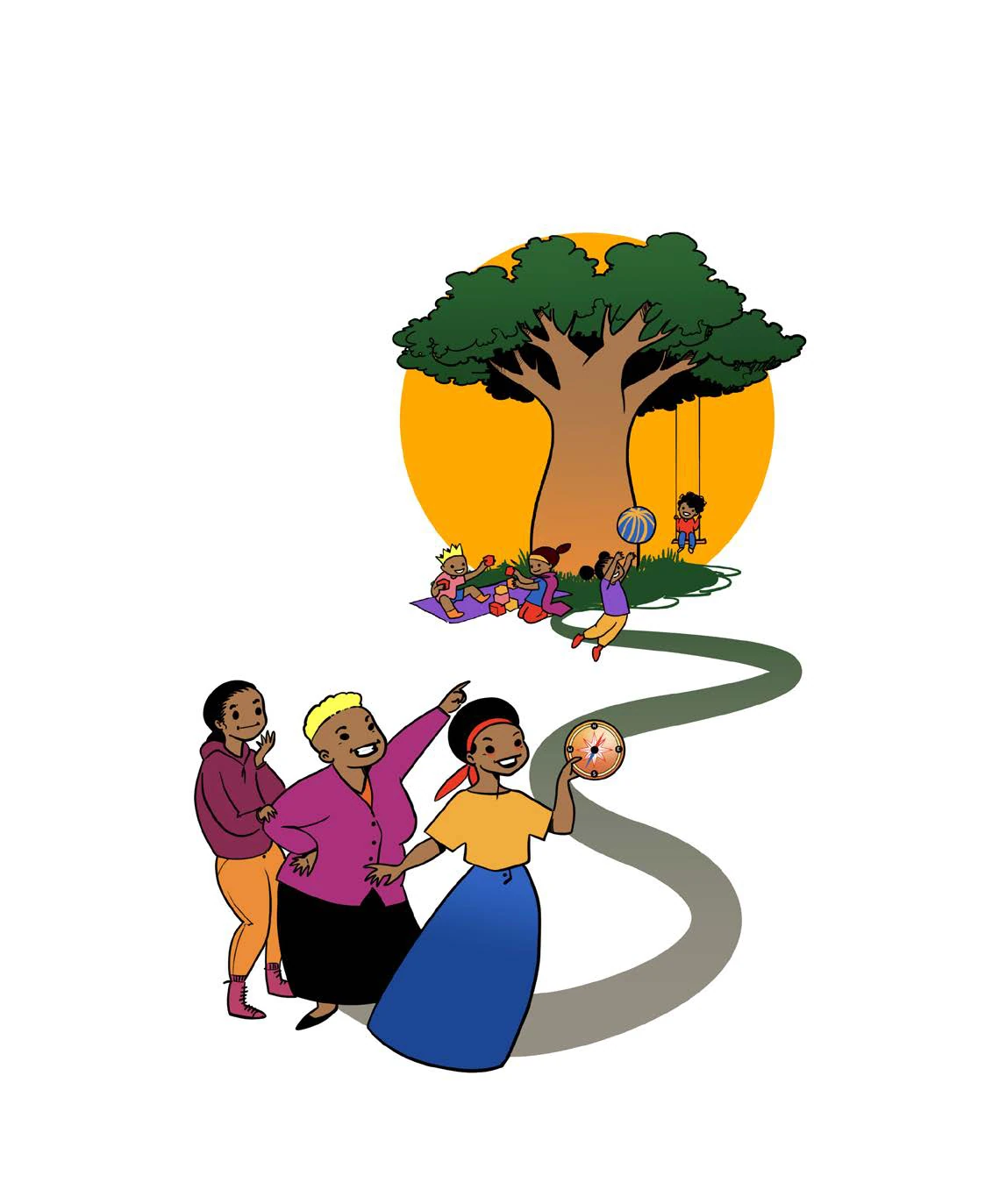
This Blueprint should be read alongside the 2030 Strategy, which sets the policy direction (why), while this document focuses on the practical steps to make that vision a reality (how). The Blueprint is not a detailed implementation plan, but rather a proposed set of coordinated actions that can move the country closer to its goal. The Blueprint is like a compass rather than a detailed map. It provides strategic direction and invites all ecosystem stakeholders to align their efforts toward a common vision. The orchestration teams, progress teams and action leads will work together to develop the detailed implementation plans needed to turn these actions into reality.
1.2FOCUSING ON EARLY LEARNING
Universal access, as defined by the National Integrated Early Childhood Development Policy, means every community has the right mix of ECD services tailored to local needs. According to the World Health Organization’s (WHO) Nurturing Care Framework, this includes responsive caregiving, healthcare, nutrition, clean water and sanitation, as well as safe, stimulating places to learn and play.
While the 2030 Strategy covers ECD broadly, from birth until the year before a child enters formal school, this Blueprint focuses on one critical and scalable entry point: expanding access to quality early learning in diverse group-based settings. This focus does not diminish the importance of health, nutrition or family support. Rather, it prioritises early learning as the area where rapid, measurable progress at scale is most achievable. Research shows that quality group learning in these formative years yields the greatest developmental impact and can be effectively scaled through targeted policies, funding and partnerships. Delivery models must therefore be flexible and inclusive, reflecting South Africa’s diverse communities so they can eventually extend to all children under five. And throughout, ELPs must complement and reinforce what families are already doing at home, recognising parents and caregivers as children’s first educators.
1.3EMBRACING MIXED-MODALITY
South Africa’s early learning system must move beyond a one-size-fits-all approach. This Blueprint embraces a mixed-modality model, recognising that programmes can and should take place across a variety of settings, including centre-based programmes and non-centre-based options like community playgroups, mobile services and home-based models.
This diverse mix allows early learning services to reach more children, reflect local cultures and languages and adapt to different geographies and resource levels. Far from hindering scale, diversity enables it. Regardless of setting, every programme must meet minimum health, safety and quality standards to ensure every child can thrive.
1.4REDUCING FRICTION TO CHANGE
Unequal access and inconsistent quality are not random but tied to longstanding, interconnected frictions: historical inequalities, persistent poverty, structural hurdles and fragmented delivery models that have shaped the sector for decades.
This Blueprint refers to these challenges as the implementation gap, which has two parts:
- Access Gap: Due to inadequate coverage, many children, particularly those in marginalised communities, still lack access to early learning opportunities.
- Quality Gap: Even where children do attend programmes, learning experiences often vary greatly, limiting developmental outcomes for children.
Though daunting, these gaps also present clear opportunities for change. Every point of friction reveals where the system can, and must, evolve.
Instead of applying small-scale fixes or isolated pilots, we can turn barriers into enablers.
Where coordination has been weak, we must invest in shared support systems and unlock collaboration through shared data, interoperable platforms and aligned policies. Where local providers and communities have been isolated, we focus on support and shifting decision-making closer to the ground.
This is fundamentally a systems challenge. For too long, dedicated actors have worked in isolated walled gardens, each cultivating their own beautiful space, creating islands of excellence in a challenging environment. While these gardens are a testament to the sector’s resilience, creativity and commitment, and deserve to be celebrated, the time has come to think bigger and bolder.
This Blueprint invites those who have nurtured these celebrated spaces to open their gates and connect with others, transforming walled gardens into a thriving, interconnected forest ecosystem. In a forest, diverse roots intertwine underground, sharing resources and strengthening the whole. Above ground, varied branches reach toward sunlight, each unique, yet all growing together.
This is the shift we are calling for: from beautiful walled gardens to a resilient forest ecosystem flourishing together. Not uniformity, but rich interdependence. Not competition, but collective growth. Working in new ways, so that every part supports and sustains the others, and every child can thrive.
1.5ORCHESTRATING COLLECTIVE ACTION
No single organisation can close the early learning gap alone. A resilient, sustainable system depends on coordinated action across government, civil society, communities nd the private sector.
This document is a Shared Blueprint, a common foundation for all ecosystem actors, irrespective of size, to co-create aligned action plans for 2030. It is a flexible guide, not a rigid prescription, designed to harness collective strength for universal, quality early learning.
While some collaborative structures exist, such as local community forums and intersectoral platforms, more dedicated orchestration is needed. This includes leadership teams, multi- stakeholder design processes and high-level governance structures to ensure transparency, continuous learning and adaptive implementation. This orchestration team structure will be described in Chapter 4.
1.6WHAT’S NEXT
This opening chapter has introduced the vision and role of the Blueprint as a dynamic roadmap for collective action. Chapter 2 explores the scale and urgency of the exponential challenge ahead; Chapter 3 maps the diverse actors, assets and support systems in the early learning ecosystem; Chapter 4 outlines the five-stage rollout strategy; Chapter 5 details how roles are being strengthened; Chapter 6 focuses on transforming public narratives about early learning; and Chapter 7 energises the network to drive a coordinated, national movement for impact.